

Edmonton zoning reform marks an important turning point in how the city approaches growth and housing policy. Much of the public conversation has centred on the “Missing Middle” — what it is, where it belongs, and whether it represents progress or disruption.
Town halls, comment sections, and neighbourhood discussions often focus on building types: duplexes, row housing, and small-scale multi-unit developments.
Much of the debate surrounding Edmonton zoning reform has often focused on building typologies rather than long-term fiscal sustainability. The imagery is tangible. The reactions are emotional.
The reactions are emotional. And understandably so — change in the built environment is never abstract.
However, the Missing Middle may be only the visible surface of a much deeper civic question.
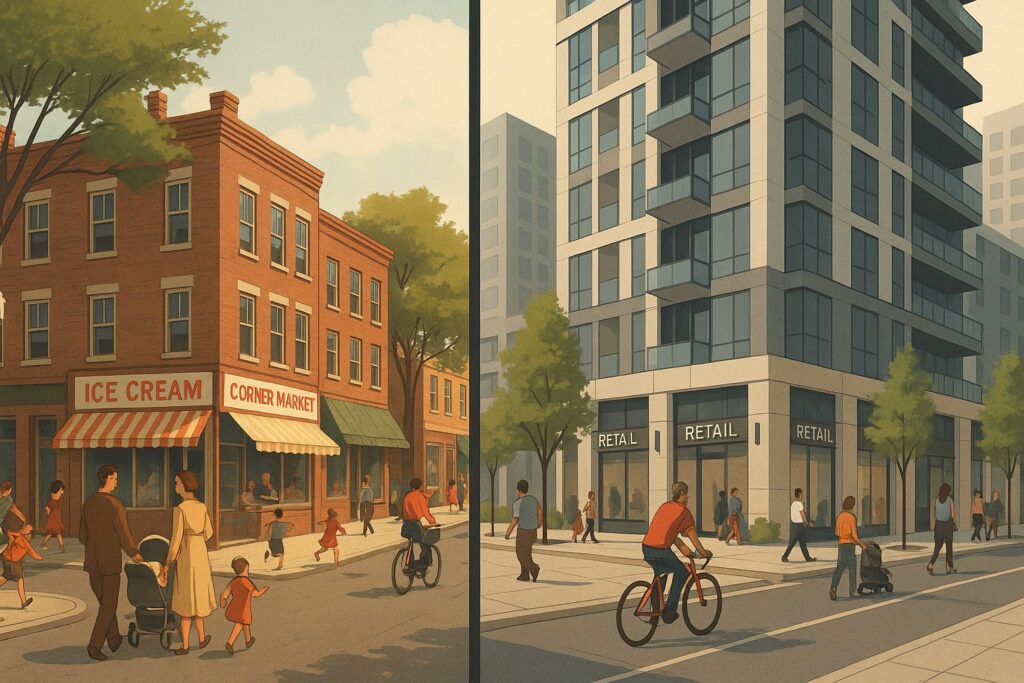
Zoning reform is not simply about housing typologies.
It is about how a city chooses to grow.
It reflects decisions about infrastructure, long-term finances, neighbourhood identity, and fairness across generations.
What Is the Missing Middle and Why Has It Become the Symbol?
Planners coined the term “Missing Middle” to describe housing types that sit between single-detached homes and high-rise apartment buildings. Duplexes, fourplexes, townhouses, and small courtyard apartments — forms that were once common in many North American cities — gradually disappeared from zoning maps over the past several decades.
In Edmonton, as in many growing cities, zoning reform has reopened the door to these typologies. Supporters argue that they offer flexibility, incremental density, and greater housing choice. Critics worry about neighbourhood character, parking pressure, and infrastructure strain.
Both reactions are understandable.
Yet the Missing Middle has taken on a symbolic weight that may exceed its technical scope. It has become a proxy for broader anxieties about change — about who moves in, what streets look like, and whether long-standing patterns of growth are being rewritten.
When debates focus solely on building form, we risk overlooking the structural forces shaping the city beneath the surface.
Growth policy isn’t just about what we allow to be built — it’s about the long-term obligations we choose to carry.
Marcelo Figueira
Edmonton Zoning Reform: The Real Question of Growth
If the Missing Middle has become the symbol, the deeper issue is growth.
For decades, Edmonton has expanded outward — extending roads, utilities, transit routes, and public services across a widening urban footprint. This model has delivered space and relative affordability, but it has also created long-term infrastructure obligations that accumulate over time.
Moreover, every kilometre of roadway must be maintained. In addition, every new subdivision requires snow clearing, emergency response coverage, schools, parks, transit service, and eventual asset replacement. Ultimately, growth is never neutral. It shifts costs across space and across generations.
Ultimately, zoning reform, therefore, is not merely about permitting duplexes or row housing. It raises a strategic question: should Edmonton continue to rely primarily on outward expansion, or should it rebalance toward reinvestment and incremental intensification within established neighbourhoods?
This is where the debate shifts from architectural form to civic stewardship.
The question is not whether a fourplex fits on a block.
It is whether our growth pattern aligns with fiscal resilience, infrastructure efficiency, and long-term community stability.
Beyond the Symbol
The Missing Middle may indeed play a role in diversifying housing options and creating incremental density. But focusing exclusively on building types risks narrowing the conversation, which should be fundamentally about civic direction.
Cities are shaped not only by what they permit, but by the long-term commitments they make — to infrastructure, to financial sustainability, and to future generations.
If Edmonton’s zoning reform is to succeed, the debate must move beyond symbolism and toward a shared understanding of how we intend to grow.
The real question is not whether change will happen.
It is whether we are shaping that change intentionally — and responsibly.
I first shared this reflection on LinkedIn. The full version is part of our ongoing work on urban growth and zoning reform.


Leave a Reply